A robot can move precisely and still create danger if people can't tell what it will do next. Human-robot communication gives workers a clear way to send commands, read status, and stop a task before a small error becomes an injury or damaged part.
- Clear signals show when a robot is moving, waiting, or blocked
- Simple commands reduce mistakes during handoffs
- Good feedback helps workers spot faults before restarting a task
Communication is more than speech
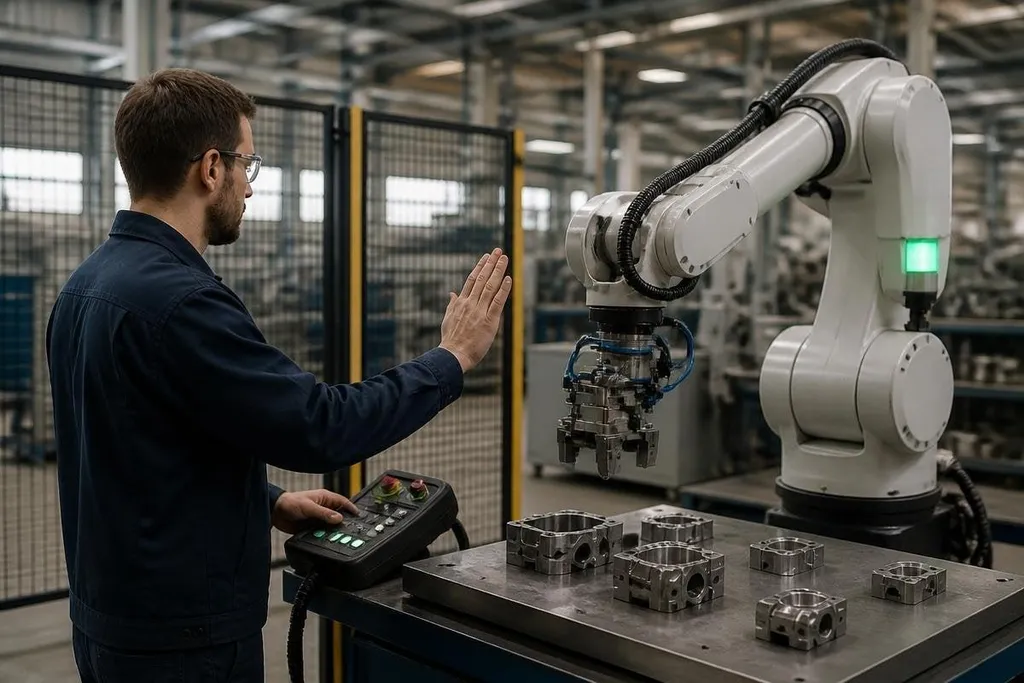
People and robots exchange information through buttons, lights, screens, sounds, gestures, and software. A worker may press a start control, while the robot answers with a light pattern or message that shows its current state.
That exchange works only when each signal has one clear meaning. A red light might mean a stopped motor, an open safety gate, or a low battery. If the same signal covers several faults, the worker has to guess what happened before taking action.
The robot also needs to show intent. A moving arm should make its path clear through position, speed, and warning signals. A mobile robot should show where it is going before it turns into a shared work area.
These details matter during handoffs. If a person places a part in a fixture and the robot starts before the part is secure, the issue may begin with a missing confirmation rather than a bad motor or sensor.
Feedback keeps small faults from growing
The system needs to report more than success or failure. It should show when a task is delayed, when a part is out of position, and when a safety stop has removed power from motion.
That information gives the worker a path to the next action. “Part missing” points to the loading area. “Door open” points to the cell gate. “Motor fault” may require a technician with the correct training.
Good feedback also supports recovery. After a stop, the worker needs to know what caused it, what the robot has retained in memory, and what must be checked before the task starts again.
A restart button without that information can turn a safe stop into a repeated fault.
A robot's message needs to tell you what changed and what you can do next. Human-robot communication reports from Robot24.com can tie that message to the machine's next action, giving the next section a clear test for predictable behavior.
Trust comes from predictable behavior
Workers don't need a robot to act like a person. They need it to behave in a way they can learn and predict. A robot that follows the same start, stop, and warning rules is easier to work beside than one that changes its signals from task to task.
Predictability also shapes training. A new worker can learn what a light, sound, or screen message means and connect it to a safe response. If the interface uses unclear terms or hides the reason for a stop, training takes longer and mistakes become harder to trace.
Speech can help in some settings, but it isn't a complete answer. Factory noise, accents, blocked microphones, and nearby conversations can affect spoken commands. Physical controls and visual status displays still matter when a voice system can't hear the worker correctly.
I’d treat human-robot communication as part of the machine, not a screen added after the machine is built.
What to check before deployment
Use this guide when you review a robot cell or automation project:
- Map each state: list the signals for ready, moving, paused, blocked, and stopped
- Test the handoff: check how the robot confirms that a person has loaded or cleared a part
- Read the fault message: make sure a worker can tell what happened and what action comes next
- Check the stop path: confirm that people can reach the emergency stop from normal work positions
- Try noisy conditions: test lights, screens, buttons, and sounds with the equipment running
- Record recovery steps: write down the checks required before the robot restarts
This check also exposes gaps that a speed or payload test may miss. A robot can meet its motion targets and still slow production if workers stop it often because its status is unclear.
What comes next
Better communication won't remove every risk. It can give people clearer signals, reduce guesswork, and make faults easier to handle before the next task begins.
The useful test is plain: can a trained worker tell what the robot is doing, why it stopped, and what to check next without guessing? If the answer is no, the cell needs better communication before it needs more automation.